


Same but different: Why have more than one name for your international brand
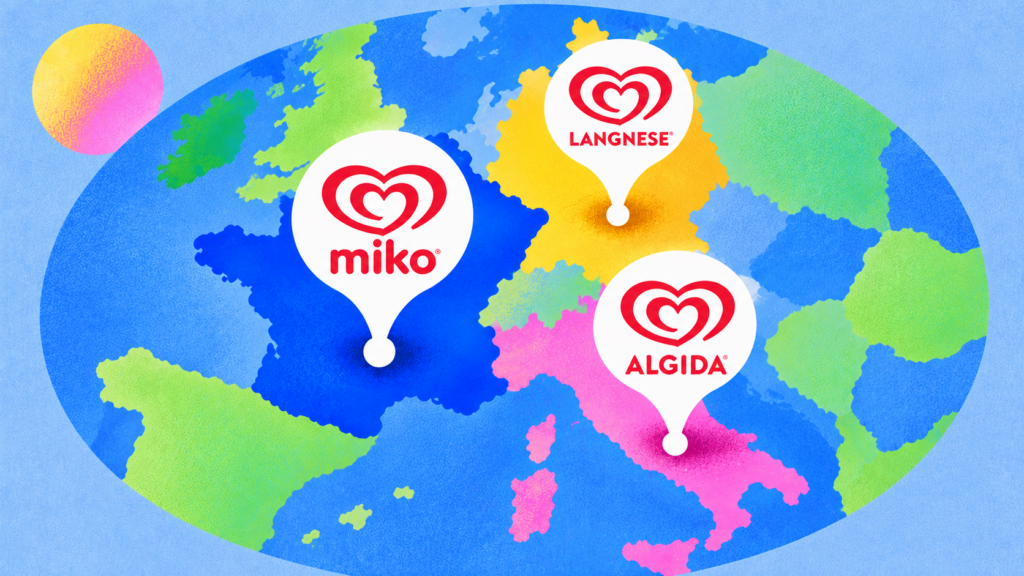
Looking around the supermarket on holiday, have you ever come across a brand that looks familiar, but there’s something a little off? Be it the logo or the typeface, the product uses the same visual elements across the globe, only one thing has changed: the name.
International brands adapt their naming for individual national markets more often than you would think. Our mission as an international naming agency has always been to create brand identities that span diverse linguistic and cultural contexts. At times this involves the development of an international naming strategy with several names for a variety of reasons and objectives.
Preserving existing brand reputations in local markets rather than forcing international integration
Take the example of Miko, the known and loved ice cream brand first developed in 1920s France. Today, the iconic red heart logo is accompanied by a multitude of names across regional markets. Frigo in Spain, Algida in Italy, Langnese in Germany, and Wall’s in the UK; why would any brand want to have so many identities?
The answer comes from a history of acquisition. As a global leader in consumer goods, Unilever is responsible for the purchase of many of the world’s most well-known ice cream businesses, including Miko in 1994. Rather than grouping their brands under a single new name, they opted to preserve the strong reputation of each local brand, building on the loyalty that already existed within each regional market. This meant that the products marketed as Wall’s to the British and Miko to the French since the 1920s would remain immediately recognisable.
A completely new name would mean building its identity from scratch and incurring the cost to remarket this unknown brand. In the case of Miko and Unilever, the use of several different names was clearly the strongest strategy.
Prioritizing cultural sensitivity by tailoring new brand identities to break into specific regional markets
In some cases, multinational companies make the conscious decision to develop new brand identities for each local market when pursuing international expansion. Australian personal care brand Rexona was created in 1908 before being acquired by Unilever and expanding progressively to become a leading name in deodorant today.
When internationalising, Sure was the name chosen for the UK market to convey a clear message of reliability, lending itself to the creation of catchy slogans such as “Raise your hand if you’re Sure”. This works well for an English-speaking audience, but the name does not transfer well linguistically to other European audiences. The word “sure” could be pronounced in a multitude of ways in different European languages, making the use of the original name Rexona much more appropriate.
However, when it came to the US market, Unilever had to be sensitive to existing brands and trademarks. Although the brand Sure would have been a good cultural and linguistic fit, the presence of an unrelated Sure antiperspirant brand blocked the use. This led to the creation of the company’s third name: Degree.
Some choices focus on linguistic sensitivity. Launched in the United States in 1958, cleaning product company Mr Clean created a character to embody their brand identity. The iconic buzz cut, white t-shirt and arms firmly crossed remain unmissable, but this man is known by many names, whether that’s Monsieur Propre in France, Meister Proper in Germany, or Don Limpio in Spain.
Procter & Gamble, the American owner of Mr Clean, settled on directly translating the name into the native languages of target regional markets around the world. A strong strategy, especially when a brand has a clear visual identity already. The character of Mr Clean allows for the brand to be internationally recognised, even under all its different local names. By keeping the word “clean” translated in every name, the use of the product is clearly communicated around the world.
Our international approach at Nomen
In 2022, French audio storytelling company Lunii approached our naming agency with the ambition to launch in Spain. Needing help with a new name to adapt the brand to the language and culture, the focus was on maintaining their values of imagination and curiosity while drawing on our linguistic expertise. Representing their adventure into new international territory, Stelii was born. Validated by our international network of linguists, the name Stelii retains an identical ending using two “i”s, not only to link the two names, but also to refer to the core values of imagination and inventiveness.
Adapting a name to fit the culture and language of the target regional market to have the strongest impact or preserving the existing reputation of a successful brand; the lesson here is that consistency is not always key. Whether you are an established brand or a start-up looking to grow in new markets, Nomen is your naming agency to partner with for international development.