


Agricultural Naming: Will the next groundbreaking tractor be named “Kevin”?
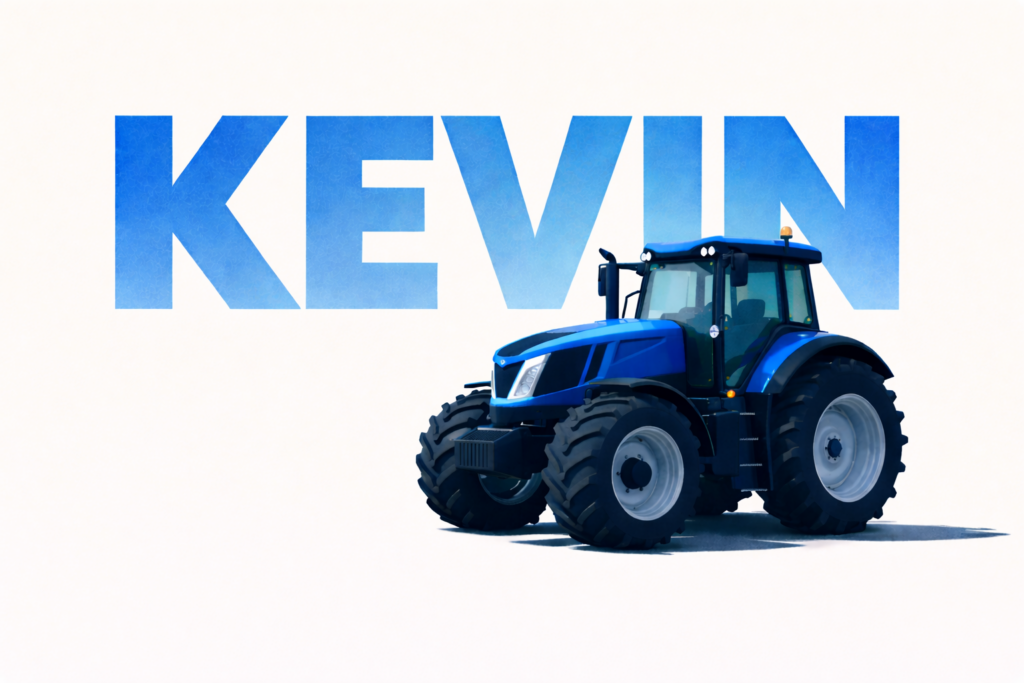
This week the Salon International de l’Agriculture opens its doors to the 2026 Paris exposition and trade fair. Imagine stepping into the exposition to see the unveiling of the next state of the art, AI-powered agricultural robotic tractor. A magnificent feat of machinery, fully autonomous, capable of analysing soil and weather conditions instantaneously. And the name of this machine, destined to transform agriculture as we know it? … “Kevin”.
The conventions of agricultural naming
As agricultural technology becomes more sophisticated with AI-powered autonomy transforming the industry and establishing a shift from machinery functioning solely as a tool to acting as a partner in the field. Current tractor names frequently oscillate between tradition and futurism. Traditional agricultural product naming vocabulary emphasises strength and scale, as in Case IH’s Magnum1, evoking power and vigour, while brands like John Deere lean into futuristic suggestions of technology and autonomy, as with the StarFire 70002, signalling cutting-edge satellite-guided precision.
These names have been strategically chosen to appeal to customers’ desires of reliability, precision and confidence in their significant investment. Strong naming strategies differentiate a product within a crowded market and must function on multiple levels; also aligning with the identity and overarching values of a brand. StarFire 7000 is a prime example, promoting the ingenuity of the product as well as the aspirational goals of John Deere, “reaching for the stars” and demonstrating their aspirational investment into future-proof farming solutions.
Why not name the next groundbreaking tractor Kevin?
Of course, this hypothetical name presents as informal, trivial, and certainly unconventional for the industry, but might this very anthropomorphism present a branding advantage? Familiar or personable names can construct a sense of trust and attachment to a product, a practice that has been used, formally or informally, for millennia. In maritime tradition, sailors have long attributed female names to their vessels and consistently refer to them as “she3”, a linguistic habit that reinforces a sense of respect, trust and partnership between humans and the world around us.
How has AI moulded product naming?
In a modern context, the personification of technology has become an increasingly common branding strategy to ease the transition into autonomous artificial intelligence as it enters commonplace. Voice assistants such as Amazon’s Alexa and Claude AI demonstrate how familiar human names can soften the perceived distance between user and machine. Giving recognisable identities to devices eases their adoption and lessens the dissonance of interacting with such advanced technology.
Will we see this evolution in agricultural naming?
A name like Kevin is approachable, personable, and agreeable – qualities that are arguably highly beneficial to the adoption of AI systems into the agricultural industry. The user demographic of farmers tends to be older than that of most artificial intelligence products4, with this comes greater caution to unfamiliar products. The integration of fully autonomous machinery presents a significant financial commitment to a completely foreign product. Consequently, manufacturers are asking farmers to place their full trust in the reliability and long-term value of the technology that they do not fully understand. As a result, a human name can act as reassurance, mitigating the perceived complexity of innovation and reducing natural psychological barriers of the fear of the unknown.
This almost “guerilla marketing” tactic of a name that almost diametrically opposes traditional product naming of tractors and farming equipment presents its own benefits. The shock of such an unfamiliar name within the market will surely capture the attention of the entire industry, becoming instantly memorable, sparking curiosity and discourse in a market where differentiation can be difficult to communicate directly. The shock value alone would act as a hook for media attention, drawing potential clients in to explore the innovation and human-centred design behind the product.
The risks of implementing modern naming strategies into traditional industries
Such an obscure branding strategy does of course carry with it many drawbacks and risks. As mentioned, the farming industry is fundamentally very traditional. The name Kevin for a tractor could very well be perceived to undermine the robustness of such a carefully engineered piece of machinery and alienate a large proportion of the target market. Furthermore, a name like Kevin threatens the reputation of an established agricultural brand and may somewhat trivialise any hard-earned recognition. In a sector where trust and credibility are crucial, a name that feels frivolous risks distracting from the qualities that justify significant investment.
Although it is highly unlikely that any manufacturer will name their next automated tractor Kevin, this thought experiment presents some of the many captivating facets of the world of naming. A single word can frame how innovation, reliability and competence are perceived. There is a striking quality to this simple, almost banal name that feels so familiar yet so bizarre in this context that its very humour may evoke accessibility and humanity. This hypothetical naming game also underscores the tendency to anthropomorphise objects, a uniquely human trait that helps us to better connect with the world around us. When used effectively, this can be a powerful marketing tool, such as in the case of Amazon’s Alexa, however this requires attention and must align with the target audience as well as the brand’s image.
Maybe one day fields won’t be full of tractors – but of Kevin’s. For now, however, this question serves as a useful reminder of the power and limitations of humanity in naming.
Sources
1https://www.caseih.com/en/africamiddleeast/products/tractors/magnum-series
2https://www.deere.lu/fr/agriculture-de-precision/elements-essentiels/recepteur-starfire-7000/
3https://www.clippermarine.co.uk/news/why-are-boats-female—
4https://www.bbc.com/future/bespoke/follow-the-food/the-ageing-crisis-threatening-farming/